Interstate 44 runs 650 miles from the St. Louis region to North Texas, connecting one of the most concentrated clusters of aerospace manufacturers, defense contractors, and suppliers to the aerospace and aviation industry in the United States. Every major node along that corridor – Tulsa and Oklahoma City in Oklahoma, Fort Worth, Texas – depends on surface transportation to move components, sub-assemblies, and finished systems between facilities. The St. Louis region is positioned at the origin of that artery, where the corridor serving some of the bi-state area’s highest-value manufacturing operations begins.
Introducing the I‑44 Aerospace Supply Chain Corridor:
The Logistics Backbone of America’s Aerospace Industry
As the origin point of I-44, the St. Louis region is positioned at the gateway to a continuous aerospace manufacturing and supply chain artery stretching southwest through Tulsa, Okla., Oklahoma City, and into the Dallas-Fort Worth metro area (via I-35 to the south from Oklahoma City). This corridor represents one of the densest concentrations of OEMs, Tier 1 suppliers, maintenance, repair, and operations companies, and defense contractors in the nation. The St. Louis bi-state area is bolstered by key players that have organically clustered in the region over decades, creating an ecosystem that supports growth.
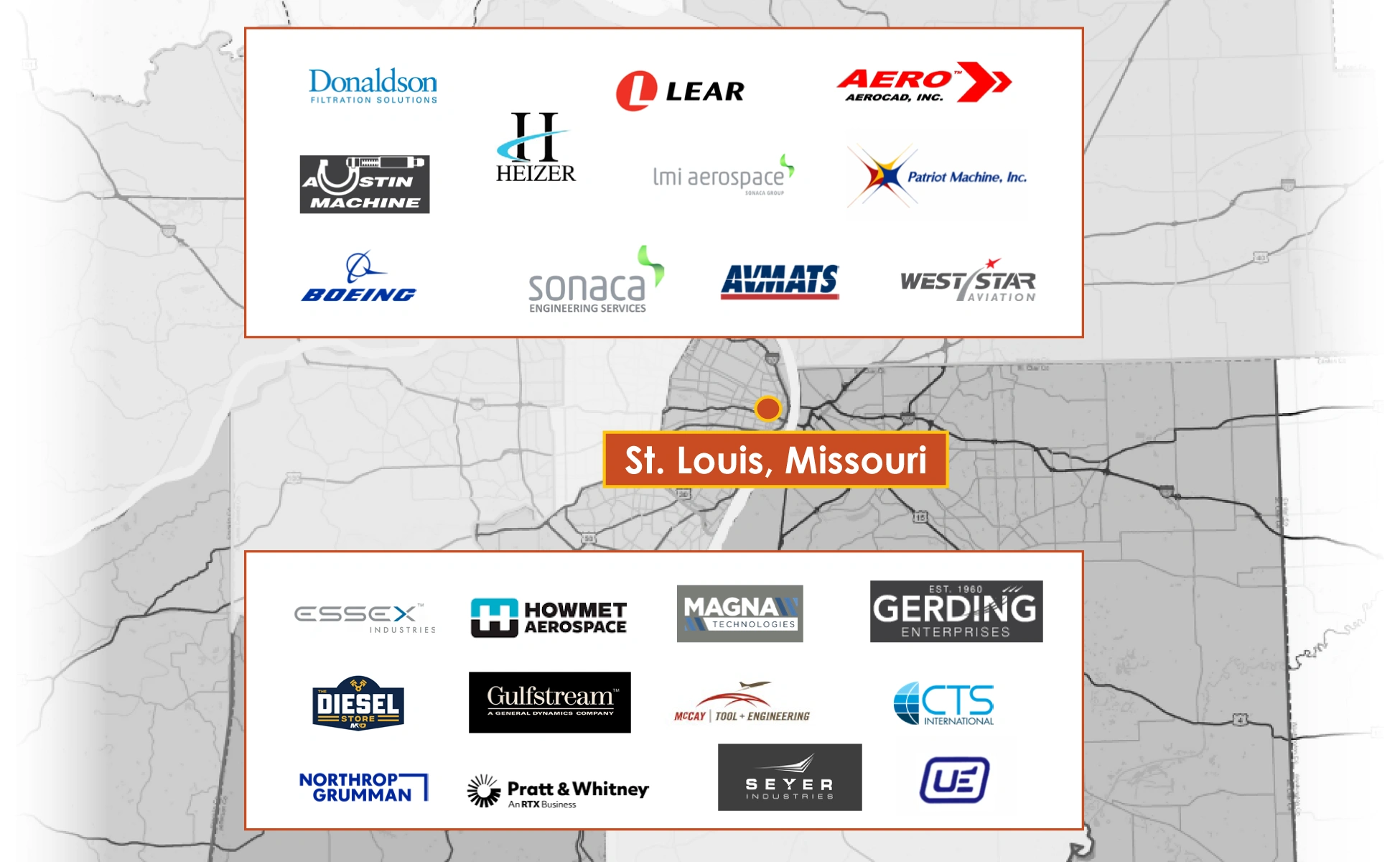
Aerospace Companies in the St. Louis Region
-
Boeing Defense
Boeing Defense anchors the region’s manufacturing base, producing F/A-18s, F-15EXs, and next-generation platforms from its St. Louis campus, representing the highest-value production node on the entire corridor. St. Louis is home to Boeing’s Defense, Space & Security Headquarters, and in March 2025 Boeing announced the multi-billion contract to build the F-47 – the United States Air Force’s newest sixth-generation fighter jet. Boeingis also expanding the production in St. Louis for the F-15EX and will increase to two per month in early 2027 with deliveries set to begin in early 2028. These announcements reinforce the region’s role as a national aerospace and defense hub that is also complemented by the recent opening of the $1.7 billion National Geospatial Intelligence Agency in St. Louis serving as the agency’s western headquarters.
-
St. Louis Lambert International Airport
St. Louis Lambert International Airport, directly adjacent to Boeing’s operations, is undergoing a $3 billion-plus terminal modernization that will transform the region’s global air connectivity and, combined with Boeing’s expansion, is projected to generate more than $32.4 billion in new annual economic impact and more than 133,000 jobs by 2032, according to the St. Louis Business Journal.
-
MidAmerica St. Louis Airport
Across the Mississippi River, MidAmerica St. Louis Airport has evolved into an active aerospace manufacturing site. Boeing’s new $200 million, 300,000-sq-ft production facility at this location now manufactures the MQ-25 Stingray, the U.S. Navy’s first carrier-based unmanned aerial refueling aircraft. The airport itself recently completed a $34 million project to double its terminal and a $37.7 million taxiway investment, and construction is underway to add a new Federal Inspection Station to its newly constructed General Aviation Facility for U.S. Customs and Border Protection. A new MetroLink extension totaling approximately $100 million will connect MidAmerica St. Louis Airport directly to St. Louis Lambert International Airport, linking the two airports into a single, integrated aviation system.
-
Scott Air Force Base
MidAmerica St. Louis Airport shares its runways with Scott Air Force Base (SAFB), and that relationship defines the region’s strategic ceiling. SAFB is home to both Air Mobility Command and U.S. Transportation Command, the command-and-control center for all Department of Defense global logistics across air, land, and sea. A 2026 study by Steadfast City Economic & Community Partners puts SAFB’s annual economic impact to the region at $12.9 billion. Boeing’s drone manufacturing, military flight operations, and commercial aviation all operate from the same airfield. That integration of civilian production and defense logistics infrastructure exists nowhere else on the corridor.
-
Sonaca North America
Sonaca North America (formerly LMI), is a leading supplier to the commercial, business, regional and defense aerospace markets and has nine factories across the United States, five of which are along or in close proximity to I-44. These include plants in Washington, Mo., Cuba, Mo. and Tulsa, Ok., – all directly served by I-44 – as well as two plants and the company’s headquarters in St. Charles, Mo., just a few miles north of I-44. Every part the company produces at the St. Charles or Washington plants goes to Cuba or Tulsa for surface treatments, with many being shipped from there back to St. Louis or Fort Worth, Texas. Customers include industry giants such as Boeing and Gulfstream as well as other suppliers like Patriot Machine, Inc. and Spirit AeroSystems.
For Sonaca, being in Missouri with locations along the I-44 artery contributes to our success because we can be competitive with other suppliers that may have everything on one campus. Easy access and easy connections along I-44 were factors as the company expanded through acquisitions and they continue to support movement of our products between our facilities. It’s the closest we can get to being a one-stop shop.
Kevin GoossensCEO, Sonaca North America
Tulsa has Spirit AeroSystems; Oklahoma City has Tinker Air Force Base and the Federal Aviation Administration Mike Monroney Center; Fort Worth has Lockheed and Bell. Each is a formidable node, but none holds the origin position, which is the point where a prime-level defense manufacturer, the world’s preeminent military logistics command, two international airports under active expansion, unmatched rail and barge access, and the interstate artery of the entire network all converge.
That convergence is the St. Louis region… and the corridor takes off from here.
Aerospace Manufacturing Employment
(NAICS 3364 & Associated Industries)
What is NAICS 3364?
The North American Industry Classification System (NAICS) standardizes the way industries are categorized throughout North America. The primary goal of NAICS is to enable federal agencies to collect, analyze, and publish statistical data related to the U.S. economy more effectively.
NAICS 3364 is the code for Aerospace Parts & Products Manufacturing, the official name for establishments engaged in manufacturing aircraft, missiles, space vehicles and their engines, propulsion units, auxiliary equipment, and component parts of the aforementioned products. The development and production of prototypes is classified in this industry, as is the factory overhaul and conversion of aircraft and propulsion systems.
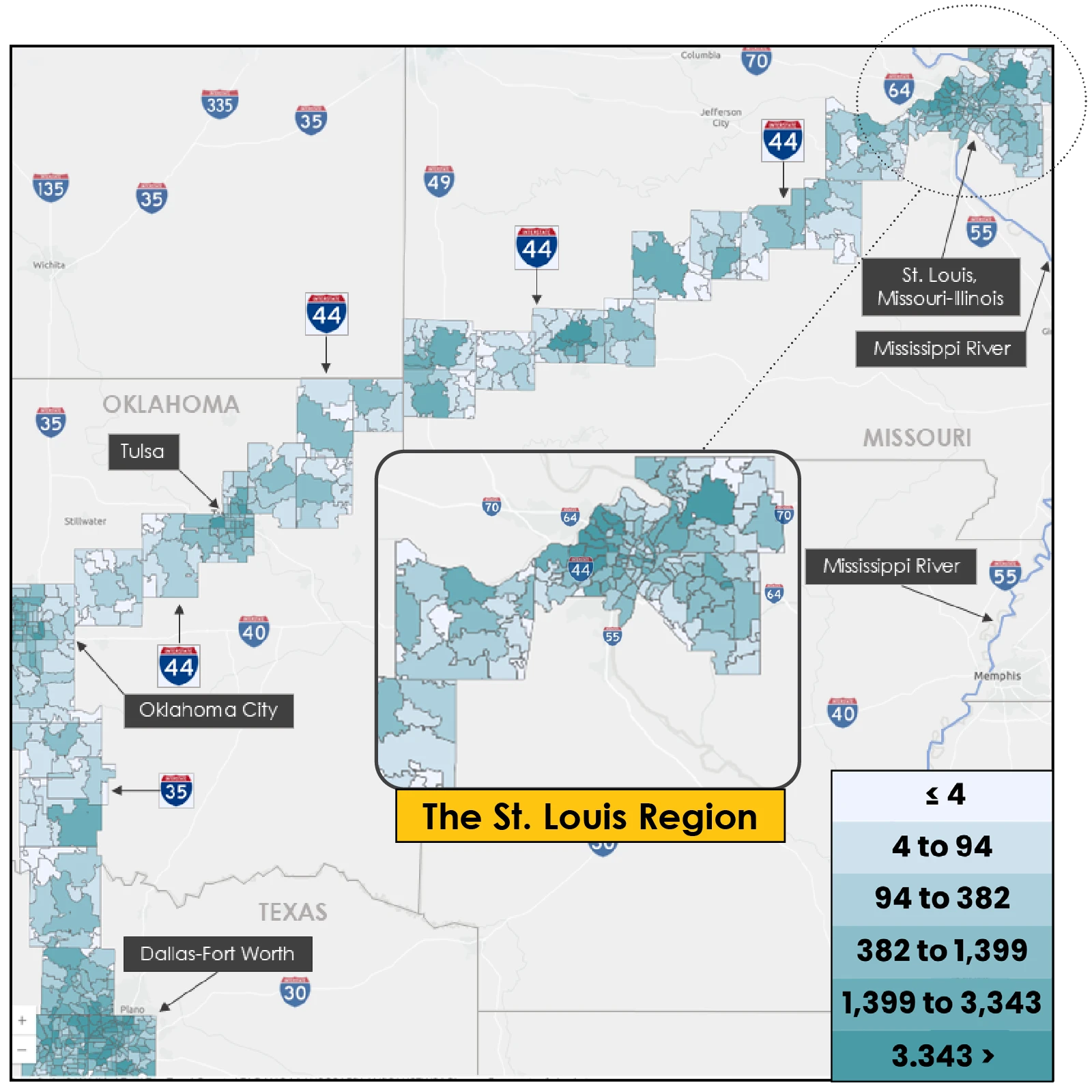
- The Adjacent Chart shows the total number of jobs in Aerospace Manufacturing (NAICS 3364) and the related secondary, tertiary, and supporting industries along the I-44 Aerospace Supply Chain Corridor.
LQ for Aerospace Manufacturing Employment
(NAICS 3364 & Associated Industries)
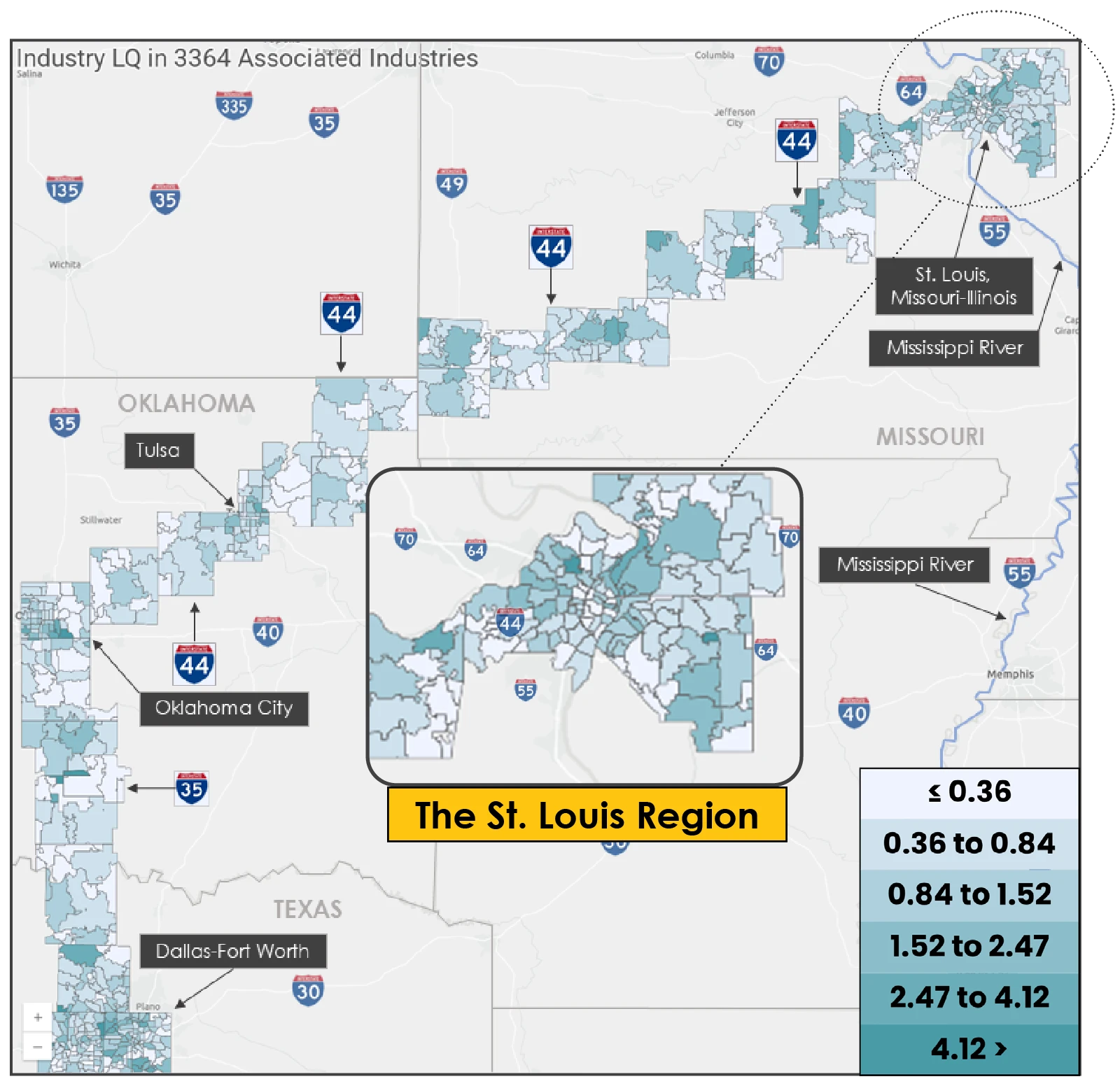
The accompanying chart shows the location quotient of Aerospace Manufacturing (NAICS 3364) and the related secondary, tertiary, and supporting industries along the I-44 Aerospace Supply Chain Corridor.
Location quotient is a measurement of concentration in comparison to the nation. An LQ of 1.00 indicates a region has the same concentration of an industry (or occupation) as the nation. An LQ of 2.00 would mean the region has twice the expected employment compared to the nation, and an LQ of 0.50 would mean the region has half the expected employment in comparison to the nation. Anything above 1.25 is a competitive advantage. The average LQ of the I-44 Aerospace Supply Chain Corridor is 2.81.
- The map shows that there is significant concentration in Aerospace Manufacturing and related jobs along the corridor in areas depicted in the deep teal color, especially in the St. Louis region, where multiple zip code tabulation areas have LQs above 4.0. This means that there is a 400% higher concentration of jobs in those areas compared to similarly sized areas in the U.S.